How are you handling Twitter?

Twitter Handle shirtDo you have a Twitter handle (ex. @RuthDobson)?  Have you ever tweeted?  Do you understand the meaning of the word hashtag?

With an estimated 200 million+ global users, Twitter is an online social networking platform of which you’re most likely already aware.

The Trends functionality within the standard Twitter profile allows users to see discussion topics in virtual real-time that are trending and most popular among other users located in different geographic locations around the world.  Basically, the Trends function allows you to quickly and easily discover sentiments of others related to current world events and global happenings, as well as countless past, present and future-related ideas and items of interest.

For example, after selecting the “Worldwide” setting within the Trends function, I discovered that the following topics were most popular among users tweeting earlier today, October 8, 2011:

#Yaris
#CosasQueNoPuedoEvitar
#BiggestLoserFinale
RIP Al Davis
GREYSON IS THE INSPIRATION
#9DAYS
UNBROKEN TOUR IN BRAZIL
Congrats LarryJEDWARD WOW OH WOW
PROUD OF 1D

Do any of the above hashtags or phrases peak your interest enough to search Twitter to learn more?  Or, would you be more interested in seeing topics that were or are trending in your local neighborhood?

Apple co-founder Steve Jobs died three days ago, and millions of global Twitter users have expressed their reactions to Jobs’ passing via tweets.  Searching the hashtag, #stevejobs, on Twitter today reveals the continued sentiments of many organizations and individuals in tweets, such as:

BrooklynBrewery The Brooklyn Brewery
Paying our respects to a man who changed the world bit.ly/qwQpdb #stevejobs

CathySal
Cathy Salazar
Retweet if you are touching an Apple product #SteveJobs #iSad

Tweet_Dec
Declan Cashin
Gawker: What everyone is too polite to say about #SteveJobs gaw.kr/rqD5xV

beppe_grillo
Beppe Grillo
[Commento] 10 years ago we had #SteveJobs, #BobHope and #JohnnyCash. Now we have no Jobs, no Hope and no Cash goo.gl/EvYkI

swoldhek
Siegfried Woldhek
A portrait of #SteveJobs. The man with golden eyes http://ow.ly/6RccO

eorlins Eliza Orlins
Walking by the #apple store at 14th street. Moved by the tribute to #SteveJobs. twitpic.com/6wody1

yoanifromcuba Yoani Sanchez
#Cuba I was born in a society where talent and desire to innovate can be politically penalized . But you inspired me #stevejobs

NewYorker The New Yorker
Steve Jobs was a great businessman. But was he a great artist? nyr.kr/o1VesB #SteveJobs

Maybe the most appropriate question to raise is not the question, “Do you have a Twitter handle?”    Maybe a better question is, “Are you using Twitter to search out different perspectives and discover different worlds?”


Find your golden mind

Gold Brain imageGoldie Hawn has penned a new book titled, “10 Mindful Minutes:  Giving Our Children—and Ourselves—the Social and Emotional Skills to Reduce Stress and Anxiety for Healthier, Happy Lives.

Through her book, through the work of The Hawn Foundation that she founded and through recent TV appearances like the one last week on MSNBC’s Morning Joe, Ms. Hawn is sending a clear message to America:  it’s time to be mindful.

The Hawn Foundation’s signature educational initiative, MindUP™, is an evidence-based, social and emotional learning program that exposes fourth to eighth graders to the Buddhist technique of mindfulness training, in hopes of reducing their stress levels, making them more self-aware and creating more optimism.

In this video, Hawn describes the program’s four-part curriculum that teaches students to 1) learn about their brains, 2) learn how to quiet their minds, 3) learn to be mindful of the senses to improve focus and 4) learn to consider their place in the world with a sense of gratitude.

In a time when all of us, children and adults alike, are being inundated with data and information like never before, practicing mindfulness is becoming more and more important for our personal survival and success.

When was the last time you stopped to take the time to quiet your mind?  Do you have a special place where you can reconnect with your authentic self, get back in tune with your passions and think creatively about how you can more positively impact your world?

For you men out there, maybe your place for mindfulness is a man-cave.  For you ladies, I’d suggest a SheCave.

Most importantly, don’t wait to reduce your stress.  As Ms. Hawn might advise: don’t miss those golden opportunities.

Designer blue jeans and descriptive nouns

CVintage 80s Gloria Vanderbilt jean pocket imageNN correspondent Anderson Cooper recently debuted his day-time talk show in the U.S. titled, “Anderson.”  Earlier this week, Mr. Cooper conducted a special interview with his mother, living legend Gloria Vanderbilt.  At 86 years old, Ms. Vanderbilt is still leading a creative life — she’s recently written a new book and is still producing her own fine art.

Ms. Vanderbilt hasn’t been a part of mainstream media focus in several years and is no longer involved in the world of fashion design.  Still, it’s likely that many women in their 30s and 40s today who are witnessing the summer-to-fall, “new” trend of colored denim jeans are recalling their childhood and teenage closets in the early 1980s where Gloria Vanderbilt designer jeans once lived.

The first statement within the Wikipedia listing for Ms. Vanderbilt includes six descriptive nouns to describe Ms. Vanderbilt as a person.  She is described as an “American artist, author, actress, heiress, and socialite most noted as an early developer of designer blue jeans.”

How many descriptive nouns would you use if you were asked to draft a similar statement to define yourself right now?  And how would you prioritize your list of descriptive nouns?  And, how many more descriptive nouns may be added to your list in the future?

How to define one’s self is a critical aspect of life.  Often individuals are passive in the task, allowing others to define their roles and contributions.  In his essay, “Self-Reliance,” Ralph Waldo Emerson urged readers to trust their own inner voices and hold steadfast to their own points of view.

With so much data being generated across traditional and new media communications channels today, the ability to make one’s own distinct voice and perspective heard among the masses of information is a significant challenge.  I wonder what related advice Emerson would give to individuals who are trying to meet this current challenge?

After watching Anderson Cooper interview Gloria Vanderbilt, I’m guessing that Ms. Vanderbilt might prefer to actively define herself further and appreciate the authors of her Wikipedia listing editing the listing to include a seventh descriptive noun: mother.

To write or not to write: that is the question.

Pen and Pencil imageThis week the CBS News Sunday Morning show featured a video segment that raised the question, “Is penmanship being written off?”  Similarly, Newsweek included an article, “Texting Makes U Stupid.”

It was interesting to observe that the programming shown on one of the largest U.S. television networks and the content highlighted in one of America’s premier print news publications both referenced the historical importance of writing and questioned the continued evolution of writing in today’s world.

No doubt, high technology has impacted modern writing.  For example, how many children do you know in recent years who have learned to punch the keys on a toy laptop or real laptop before or simultaneous to grabbing a crayon and scribbling?

Now, consider yourself and your answers to these questions:

1.  Do you actively write as part of your day-to-day personal routine?

2. Are you required by the nature of your job to write?

3. Do you currently maintain or have you ever maintained a hand-written personal journal or diary?

4. When was the last time that you hand-wrote a letter to a family member of friend?

5. When was the last time that you hand-wrote a thank you note to anyone?

6. When was the last time you wrote a story of fiction or non-fiction by hand?

7. When was the last time that you hand-wrote an essay or a speech?

8. Have you ever hand-written poetry or song lyrics?

9. What is the writing utensil that you use the most – a pencil, a pen or a keyboard?

10.  Does traditional handwriting, or the lack thereof, make a significant difference in your writing ability?

Regardless of whether traditional handwriting is dying, the proliferation of writing continues.  Millions of bloggers exist today, and millions of individuals are expressing themselves via mobile texting, Facebook, Twitter and other digital channels.

If you are among those who are engaging in less traditional handwriting and more digital content creation today, consider your future.

You may even want to read the book, “Your Digital Afterlife: When Facebook, Flickr and Twitter Are Your Estate, What’s Your Legacy?” It’s one book that’s on my reading list.


Traditions, 9/11 and ways to remember…

Things to Remember imageAccording to its Wikipedia definition, a tradition is a “ritual, belief or object passed down within a society, still maintained in the present, with origins in the past.”

What are your favorite societal traditions?  Do you get charged up by the annual advent of college or professional football season?  Which national holiday is your favorite?  Thanksgiving, Christmas or Halloween?   And, what about your active personal rituals?  Do you love a daily Cup O’ Joe or a three-mile run?  Have you ever stopped to consider how often traditions and rituals impact your life?

The dual aspect of ritual, i.e. the remembering and honoring of the past while creating a new experience in the present, is somewhat of a paradox.  With the existence of ritual, we, as society and individuals, seem to grow and change while simultaneously “saving the peeled onion’s skin” to remember and preserve our previous ways and selves.  Would you agree?  Do we find and lose ourselves in traditions?

To a certain degree, societal traditions provide a familiar path that we can walk as the world keeps changing around us and as we continue growing as individuals.  For example, as we confront the aging process, birthday celebrations can help us joyfully confront the transition.  And, when we experience the loss of loved ones, funerals and memorial services can help us navigate through the pain.

Over this weekend here in the U.S., many public memorial services will be held to recognize the 10th anniversary of the 9/11 attacks in New York City.  At the same time, many individuals will hold their own private rituals to remember all that changed in the world and in our lives that bright Tuesday morning in September 2001.

Who knows?  Maybe my fellow native North Carolinian Ryan Adams, who so famously sang on September 7, 2001, “I still love you New York,” will mark the 10-year anniversary of the tragic day by writing a new song?

How will you mark September 11, 2011?   Will you be participating in a previous tradition, or will you create a new ritual of your own?

The business of art and the art of business

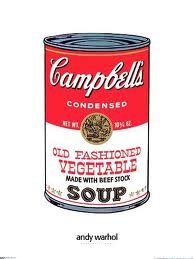
Andy Warhol's Campbells Soup

Andy Warhol's Campbell's SOUP art

It was Andy Warhol who once said, “Being good in business is the most fascinating kind of art. Making money is art and working is art and good business is the best art.”

How many of you feel that you’re creating art when you’re working?

Over the years, I have more often heard the function of marketing referred to as a science.  And, like a swan that one sees gliding smoothly over the water’s surface without seeing its swishing, working feet, when marketing is executed effectively, a lot of the science and process beneath the marketing effort often goes unseen and unappreciated by the audience.

I recently read a blog post titled, “52 Types of Blog Posts That Are Proven to Work,” and I wondered how many non-bloggers out there realize how “scientifically” crafted many blog posts are today.

Does the fact that a blog post may be created by an author who is applying a particular, learned blog-writing method matter or affect the conclusions and impressions of readers?  I think it’s an interesting question to consider.

I’d love to hear your thoughts about whether marketing is a science.  Take the poll below, and don’t let the fact that “surveys and polls” is listed as number 30 within the suggested list of 52 most-effective blog post types affect your response!

Reaching Inspired Locations

Map with Pins

Find Your Inspired Locations

From Google Earth to the FourSquare location-based networking site, there are numerous examples today to point to our continued fascination with physical locations.

What are the qualities that make a particular place special — the people, the food, the geography, the culture, or some combination thereof?

Without doubt, locations can fascinate and inspire.

I recall reading an interesting TOWN & COUNTRY article years ago that examined the city-inspired lyrics and titles of many popular songs written by some of the world’s most famous musicians.

Rough Guides recently posted a list of the Top Five Places Mentioned in Famous Songs.  And, here’s a recent Sidetracked blog post that highlights top songs written about the state of California.

As the Los Angeles-based Red Hot Chili Peppers sang in Aeroplane, music in general can be “an aero plane” that elevates listeners to another world.  When a specific city or place is called out in song lyrics, the “getaway factor” of the song can rise.

For example, when you hear Paul Simon’s Graceland lyric, “I’m going to Graceland,” where or what do you envision?   Or, when you hear Waylon and Willie sing about, “Luckenbach, Texas,” what is your response?  When Ryan Adams sings about the street La Cienega, does the lyric make you smile?  Every time I hear James Taylor sing “Carolina in My Mind,” I see the streets of Chapel Hill, the location of my college alma mater.

What locations do you think are worthy of commemoration with song?  Which places would make your “Most Inspirational Locales” list?  Give it some thought.  My list would obviously include my SheCave.


Peanut butter, poetry and sticky things

What do you think of when you hear the word, “sticky”?  “Sticky fingers,” or “sticky notes”?  Peanut butter?  Maple syrup?  Elmer’s glue?

According to wikipedia.org, in economics, “sticky” describes a situation in which a variable is resistant to change.

Yes, there are sticky situations in the world of economics and in life in general.  And, what about sticky words?  One direct quotation that has stuck with me over the years was uttered by Pearl Strachan who famously said, “Handle them carefully, for words have more power than atom bombs.”

How many striking music lyrics do we often recall?  How many lines of a poem?  How many words from a play or a movie have stuck with us over the years?  And, when do these sticky words, stated or written by others, evidence themselves in our lives?  How many of our statements are 100% original, not having withstood the influence of someone else’s sticky words of wisdom?

Without doubt, the words of our parents, of our teachers, of our favorite writers, of our favorite friends, of our favorite loves, often seem to tarry.

Shakespeare is one of the best examples of someone whose words have tarried on and on.  In his Sonnet 116, which is a favorite of mine, he wrote about the stickiness of true love stating:

Love is not love
Which alters when it alteration finds, 
Or bends with the remover to remove: 
O no! it is an ever-fixed mark 
That looks on tempests and is never shaken;”

Shakespeare wrote the words in 1609, and, in 1995, British actress Emma Thompson brilliantly incorporated the sonnet into the Sense and Sensibility movie screenplay that was adapted from the 1811 novel of the same name.  Who could forget this scene from the movie directed by Ang Lee?

What are the most sticky words you’ve ever uttered or written?  And who was listening?

Wine, Avacados and Dummies

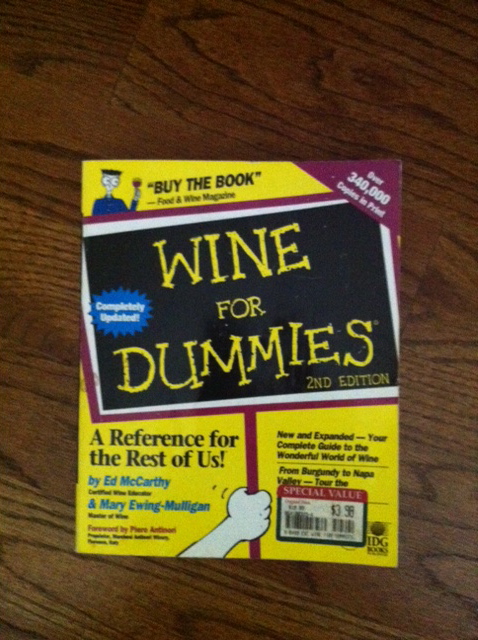
my "Wine for Dummies" book

One of the most successful book series in recent years has been the For Dummies series that began in 1991.

The roots of this book series are tied to technology.  The first Dummies book was titled, “DOS for Dummies,” and technology-focused Dummies books continue to be in abundance today.  For example, one of my coworkers has co-authored a book titled, “SAS for Dummies,” and currently maintains a blog titled, “The SAS Dummy: a blog for the rest of us.

Beyond technology, I’m amazed by the plethora of subjects covered within the series.  The For Dummies bookstore has titles ranging from “Building Chicken Coops for Dummies”  to “Acoustic Guitar Songs for Dummies,” and the DUMMIES.COM web site is now featuring step-by-step “How to Peel an Avocado” content excerpted from the “Vegetarian Cooking for Dummies” book.  I own one book, “Wine for Dummies,” from the series and reference it from time to time.

Fear of failure can be an especially strong deterrent when one is confronted with learning new things.  From a marketing perspective, I think that whoever originally coined the series name, “For Dummies,” was brave and showed no fear in banking on the fact that a majority of consumers would relate and admit to the fact that they were novices or “dummies” about many subjects.

Without doubt, the “For Dummies” marketing slogan has had broad appeal.  The books are now available in more than 15 world languages.  When it comes to learning something new, it seems everyone is a beginner, and the old saying is true: “you have to start somewhere.”

I think I’ll go acquaint myself with a glass of exotic vino.  What’s the next new thing that you’re planning to try?

You can doodle this…you can doodle that…

Yesterday, August 6, 2011, I tweeted about the fact that Google debuted its latest interactive Google Doodle to its site visitors. Yesterday’s Doodle interactive design celebrated what would have been the 100th birthday of comedian Lucille Ball and featured a TV image containing interactive remote control buttons that aired clips from Ball’s famous, “I Love Lucy!” show.

Seeing yesterday’s Doodle, I remembered previous interactive Google Doodles that I have enjoyed viewing.  I was excited to see the initial interactive Pac-Man Doodle that Google released in May 2010 celebrating the 30th anniversary of the popular video arcade game.  And, I had fun using the interactive Doodle that honored the life of American jazz and country guitar artist Les Paul to create my own “Doodle song.”  Beyond the interactive Doodles, I also enjoy viewing the creative images captured within Google’s standard Doodles.

From a corporate marketing perspective,  I have enjoyed witnessing Google as a company achieve success in maintaining its strong corporate logo and brand identity while simultaneously being “playful” with its corporate logo.  I also admire the fact that Google has created its Doodle 4 Google contest for K-12 kids.

On a more reflective note, the Doodles remind me how an attitude of openness to change, of thinking beyond the status quo and of positivity and even playfulness can have far-reaching positive effects in carrying us forward in both the personal and professional realms.  I wonder how many people who clicked the TV remote buttons on the Lucy Doodle yesterday didn’t smile and reflect on past and future possibilities?  I know that I certainly did.

Apart from all of my positive comments above, I do have some questions about Google. I recently downloaded the e-book, “The Googlization of Everything (And Why We Should Worry),” to my i-Phone, and I look forward to reading the book and learning more.

For now, I’m content knowing that, like Google’s logo, I, too, can continually evolve, change and refine my perspective.  To put it in “Google terms,” when it come to my life, I can “doodle” this, or I can “doodle” that.  It’s up to me!  So, how do you like my avatar?
Ruth Dobson-Torres’ avatar