Madeleines and Privilège de l’exécutif

French Madeleines and coffee beansThis post is part of a 2012 monthly series of MySheCave.com posts on the topic of the U.S Constitution.

When was the last time that you considered French influence within America?

American author David McCullough recently penned an interesting book, “The Greater Journey: Americans in Paris,” that provides a historical account of how many Americans between 1830 and 1900 traveled to Paris to study in the fields of art, literature, medicine, architecture and politics and then returned to influence America with their newfound knowledge gained while in France.

Today, here in the U.S., we can see that French influence into the American political arena is still alive and well.  For example, earlier this week, President Barack Obama exercised executive privilege related to the Fast & Furious gunwalking scandal.

How was President Obama’s claim of executive privilege an example of French influence into American politics?  Well, first let’s consider the definition and origin of executive privilege.

According to Wikipedia, executive privilege is “the power claimed by the President of the United States and other members of the executive branch to resist certain subpoenas and other interventions by the legislative and judicial branches of government.”

But, does the U.S. Constitution provide for this right by the Executive Branch?  The answer is no.

Wikipedia explains that the concept of executive privilege is not explicitly stated in the Constitution but that the U.S. Supreme Court has “ruled it to be an element of the separation of powers doctrine, and/or derived from the supremacy of executive branch in its own area of Constitutional activity.” 

And, according to Wikipedia, the separation of powers is a doctrine whose origins are tied to the writings of the 18th century French Enlightenment political philosopher Montesquieu, and many of the Framers of the Constitution were influenced by Montesquieu’s writings.

So, when it comes to the President Obama’s recent exercise of the political concept of executive privilege, there is, without doubt, a historical French connection.

And, who could blame the Framers of the Constitution for being influenced by the French?  Certainly not me.

The fact that I often indulge in French Madeleines with my morning coffee reveals that I also am unable to escape l’influence de la France.  🙂
 

Writing with Wooden Ink

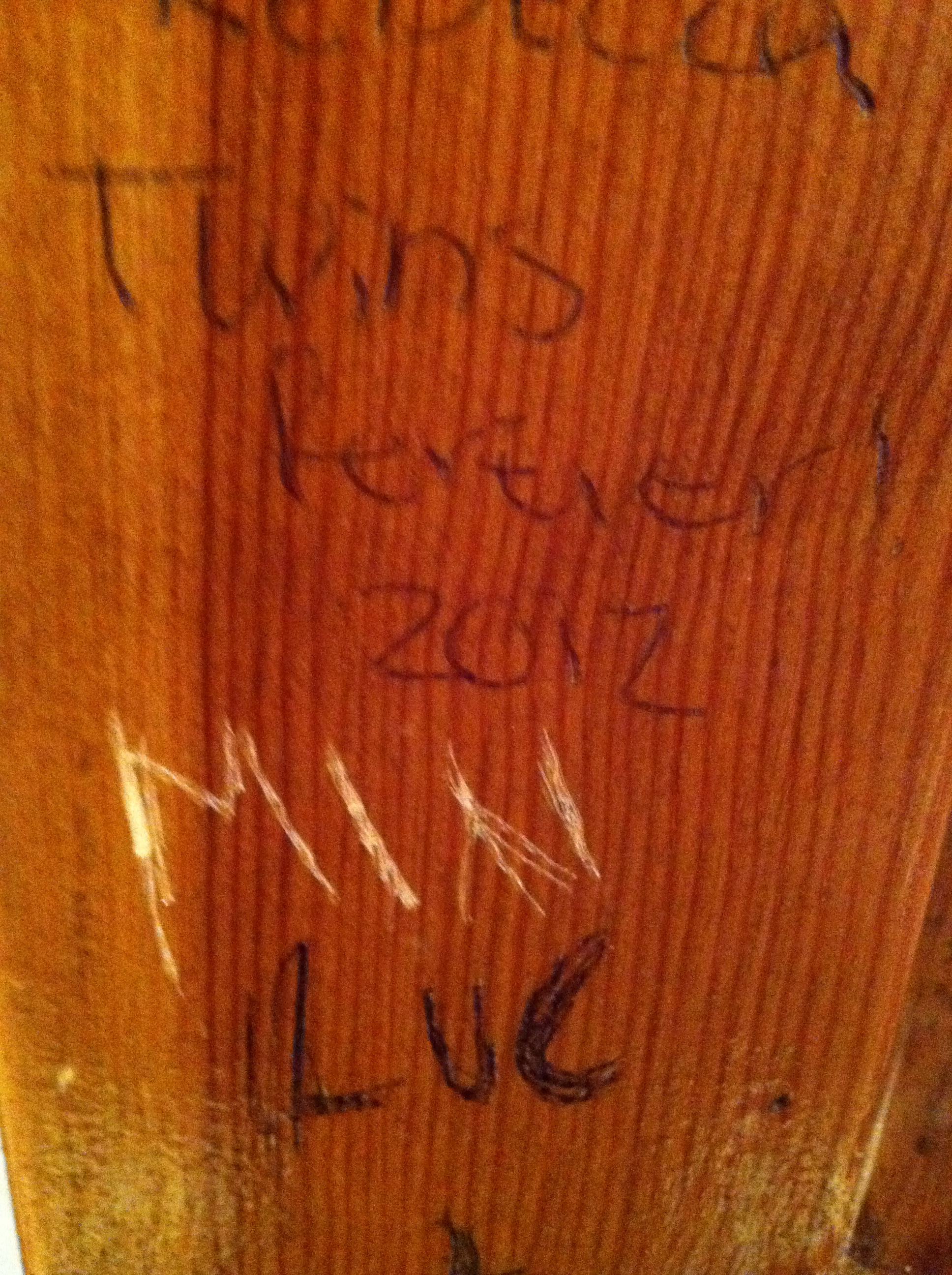
Twins Forever 2012 bathroom stall carving, Botin restaurant, Madrid, Spain

Note: This post was the first ever drafted by the MySheCave.com author using an iPad.  Drafting occurred airborne on a U.S. commercial airline flight.

While recently visiting one of the world’s oldest restaurants, El Restaurante Botin, in Madrid, I was surprised to see the message, “Twins Forever 2012,” carved into one of the old, wooden bathroom stall doors.  Being thousands of miles away from my identical twin at that moment, I was pleasantly reminded of our special twin bond.

Beyond the random bathroom stall door, I also have enjoyed reading carvings in tree wood over the years.  I remember seeing the names of local sweethearts framing a mathematical plus sign and encircled with a heart shape carved into trees in my N.C. hometown. “Jim+Kathy, 1982,” for example.

Tree carving is an old tradition, and there are interesting examples of such engravings.  Amazingly, an entire poem was carved into a beech tree in the 1840s.  “The Poem Tree,” carved by Joseph Tubb in Oxfordshire, England no longer stands, but a commemorative stone with the transcribed poem does exist, and the tree was named one of “50 Great British Trees” by Britain’s The Tree Council in 2002.

The Perryville Tree Engravings are another interesting example of tree carvings, carved on more than 100 trees in Perryville, Maryland by former psychiatric hospital patients, many of whom were mentally ill U.S. military veterans. The majority of the carved tree messages in Perryville aren’t as easy or pleasant to read as the poem on “The Poem Tree” stone or as the names of sweethearts in love.

In the spirit of today’s 2012 U.S. Open men’s golf championship, I’d like to mention another neat tree carving example.  On the grounds of his home course at the Latrobe Country Club in Pennsylvania and in honor of his father, golf great Arnold Palmer hired a local woodcarver to convert a 12-foot red pine tree into a giant carving of his father.

How many tree carvings have you seen in your lifetime?  Where were the trees that contained the carvings located?  Do you recall any specific messages?

And, last, have you ever been tempted to carve a message into a tree?  Has any person or experience moved you enough to want to carve out a long-lasting historical wooden reminder that others could find?

Watermelon Rinds and Other Delicacies

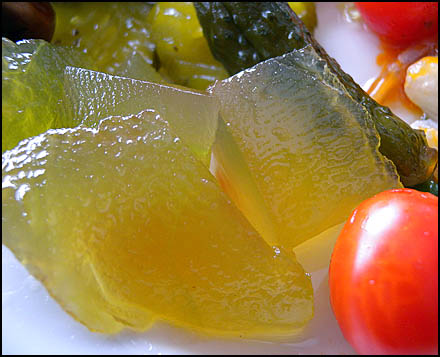
Watermelon rind pickles at The Silo Reastaurant, Greene, NY

Watermelon rind pickles at The Silo Reastaurant, Greene, NY

In a previous blog post, I asked, “Are You a Foodie?”

Now, I’d like to pose a new question:  Can you name an unusual food delicacy in your current locale?

Over this past weekend, I was reminded of a favorite Southern delicacy of mine, watermelon rind pickles, after randomly spotting a bottle of the pickles on the grocery store shelf.

I was first introduced to this southern favorite as a young child growing up in Smithfield, N.C., home of Ava Gardner and barbeque.

I recall first seeing the pickles displayed on the salad bar at Becky’s Log Cabin restaurant in the early ‘80s, and I recall initially disliking them.

Growing older, my tastes changed, and I grew to love watermelon rind pickles.  Even so, I only partake of watermelon rind pickles infrequently.  Though unusual and special, for me, watermelon rind pickles seem to be easy to forget.

It seems funny that we can forget our favorite things, doesn’t it?  But, isn’t it great to rediscover lost favorites?

Can you recall the last time you stumbled upon an item that you love but had forgotten?

And, which delicacies, food or otherwise, are unforgettable and forever emblazoned in your mind?

Paradors and B&B’s

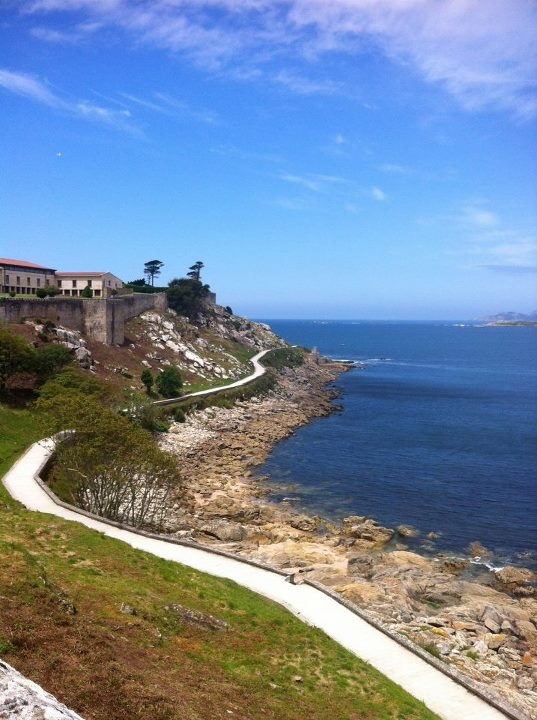
Parador de Baiona, Spain

View from the Parador de Baiona, Spain

Are you familiar with the meaning of the word Parador?

According to Wikipedia, “a parador, in Spain and other Spanish-speaking countries, is a kind of luxury hotel, usually located in a historic building such as a monastery or castle.”

In May 2012, I had the pleasure of visiting a Parador.  The Parador I visited was located in Baiona, Spain, near Gondomar, the hometown of my husband’s father.

The Parador de Baiona was gorgeous to behold and is a unique Parador, being a former fortress that overlooks the sea.

The historic Parador buildings in Spain now converted into hotels made me recall our historic homes in the U.S. that have been converted into bed-and-breakfast establishments.

Have you ever stayed at a bed-and-breakfast in the U.S.?

If so, what advantages do you think bed-and-breakfast establishments have to offer?  And, do you have a favorite bed-and-breakfast to recommend?

I could recommend The Front Street Inn, a historic B&B located in one of my favorite places, downtown Wilmington, N.C.

But, can a B&B in the good ‘ole USA compare to a Spanish Parador?  I’d rather not compare but prefer to appreciate both.  I think I could make a better comparison if I had the chance to spend a night or two in a Parador.  I guess I need to add one more item to my bucket list.