Blog Images: More than Hunky-dory

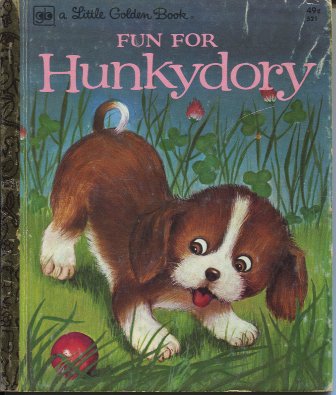
Fun For Hunkydory Little Golden Book cover

Fun For Hunkydory Little Golden Book cover

Can you recall a cover image from a favorite book that you read as a child?  One of my favorite children’s books was a Little Golden Book titled, “Fun For Hunkydory.”  After all these years, I can’t forget the book’s cover image of a cute little puppy playing in the grass.

And, consider the popularity amongst adults of the new social network site, Pinterest.  Talk about images galore!

Without doubt, pictures and images within books and media for children and adults convey meaning and can make lasting impressions on readers and users.

But, what about blog posts?  Why should a blog author include images inside a post?

I can list two reasons to include images within blog posts:

  1.  Visual Learning – Many individuals who read blog posts are visual learners.  The visual learning Wikipedia entry cites an Institute for the Advancement of Research in Education study titled, “Graphic Organizers: A Review of Scientifically Based Research,”  which concluded that “visual learning improves student performance in the areas of retention, comprehension and organization.”  If you’re trying to convey a concept within a blog post, including a relevant image will likely help you be more effective in that effort.  Also, including images within your longer posts may help keep readers interested in reading the entire post.
  2. Search Engine Optimization (SEO) – After attending a recent SEO workshop sponsored by QIC Learning and led by SEO expert Phil Buckley, I was reminded of the fact that crawling search engines today respond favorably to tagged images on blog and standard Web pages.  Properly tagged images within blog posts can help you optimize your Web site for SEO and increase the chances of your blog content surfacing higher in organic search results at popular search engine sites like Google.  The Digital Graphics Inform post, “The Importance of Tagging Photos for SEO,” provides tips for successfully tagging images for SEO purposes, and, if you’re seeking royalty-free images for your blog, check out DailyBlogTips.com’s post, “Where to Find Images For Your Blog.”

According to Dictionary.com, the word “hunky-dory” is an adjective meaning, “satisfactory. OK. fine.”

When it comes to visual learning and SEO, blog images are anything but.

Rebranding and You

Branding and Rebranding image by Laine TanMany product marketers agree that the task of introducing new products and solutions into the competitive landscape is challenging yet exhilarating.

How many times have you heard a product marketer make a post-product launch comment along the line of, “…it took tremendous effort and collaboration across multiple internal division teams, but, in the end, we delivered a new, cutting-edge solution to market, and that’s extremely gratifying.”

What about the task of marketing already-established “older” products?  Is rebranding similarly challenging and enjoyable?

Actors are often posed with the question, “Is it easier to play a villain or a good guy?”  Many actors respond by saying that it’s much easier to play the villain, the character who is more unpredictable and who delves into new behaviors, and that it’s harder to play a character who exhibits consistent good behavior to an audience.

Likewise, marketing older products, even those products that have been consistent, “good” bestsellers, may be more challenging and less exciting than promoting a product or solution that is brand-new.

What do you think?  If you’re a marketer, can you recall specific campaigns that successfully re-branded older products?  If you need help recalling, check out Judith Aquino’s article, “The 10 Most Successful Rebranding Campaigns Ever.”

And, beyond marketing, have you ever been asked to “put a new face” on a situation or to examine a set of familiar circumstances in a new way?  If so, did you enjoy that process and was it easy?

One of the biggest challenges that we face as we age is to see our lives and ourselves in a new versus old light.  Some have said that each day we live offers each of us a new opportunity to become more.

How are you doing with that task?  How are you living differently today than you did yesterday, and how will you become new as an individual tomorrow?

Passwords Protected?

Password and Username fieldsThis post is part of a 2012 monthly series of MySheCave.com posts on the topic of the U.S. Constitution.

Bob Sullivan’s online article, “Gov’t agencies, colleges demand applicants’ Facebook passwords,” is a quick reminder that questions about the U.S. Constitution and the specific liberties that the Constitution protects continue to be raised in today’s world.

The article, focused on the fact that some universities and employers are now demanding access to individuals’ private social media content, raises questions about whether those demanding organizations may be violating the rights of the individuals involved – rights that some would argue are guaranteed by the Constitution.

For example, a Washington D.C.-lawyer quoted in the article states: “I can’t believe some people think it’s OK to do this.  Maybe it’s OK if you live in a totalitarian regime, but we still have a Constitution to protect us.  It’s not a far leap from reading people’s Facebook posts to reading their email. …As a society, where are we going to draw the line?”

I was personally surprised to learn that my alma mater, The University of North Carolina, recently revised its handbook, adding a provision that requires each athletic team to “identify either a coach or administrator who is responsible for having access to and regularly monitoring the content of their team members’ social networking sites.”

Do you think that employers and universities should be able to require individuals to divulge their user names and private passwords for the social networks to which they belong?  And, if not, which individual right or rights do you think are denied when such policies exist?  Sullivan’s article references the individual right to privacy as well as to the right to free speech.

Turning back to the Constitution, do you know which Article or Amendment provides for an individual’s right to free speech?  The answer is Amendment 1, the First Amendment.  And, what about the right to privacy? Is that right protected by the Constitution?  The author of the online article, “Exploring Constitutional Conflicts,” contends that the Constitution “contains no express right to privacy.”

It seems like there are two sides to the social media coin today.  On one hand, we’ve recently seen social media tools like Twitter aid individuals in reclaiming their rights and defeating oppressive government regimes like Mubarak’s in Egpyt.  On the other hand, in the instances like those referenced in Sullivan’s article, social media technologies seem to be putting individuals’ rights at risk.

When it comes to the question of employees and universities demanding individuals to share their user names and Facebook passwords, which side are you on, and do you think the Constitution addresses the question?

Sweet Thinking

ImageGiving up sweets each year during the Lenten season can be a true sacrifice for sweet lovers.  The first few weeks are tougher than the last, but, by the time Easter arrives, the desire to partake of sugar is often an afterthought for those who have weaned themselves off of crystalline carbohydrates.

What about you?  What is your relationship to sugar?  Do you consider yourself to be a sweet tooth?

In recent years, I’ve learned to appreciate the natural sugars found in fruits like strawberries, pears, etc.  But, oh, I do recall the candies of my youth.  Candy rings and candy necklaces helped start my candy history, a history that included many Gummi bears and the chocolate bar that I had fun joking was named after me (Baby Ruth).

Below is my personal “Top 10 List of Childhood Candies” along with brief descriptions of which part of my youth that I associate with the particular sweet:

10. Lemon Drops  – My third grade teacher kept a jar of these coveted yellow candies on her desk and would rewards students with them.

9. Mr. Goodbar – These chocolate bars were a routine, post-ballet class reward, along with Cherry Coke and peach ice cream scoops.

8. Now & Laters – Throughout the middle school years, an afterschool treat.  Favorite flavors:  green apple and banana.

7.  Nerds – Boxes of these tiny treats contained either one or two flavors and often were part of care packages received during the summers while away at Camp Morehead By the Sea sailing camp in eastern North Carolina.

6. Milk Duds – A “go to” chocolate and caramel candy often chosen while on high school dates at the local movie theater.

5.  Skittles – Hands down, the choice during junior high years while playing board games like SorryLIFE and Monopoly with friends.

4. Life Savers and M&Ms – Often devoured after eating pizza at many a middle school-age girlfriend’s “spend-the-night,” sleepover party.  The green-colored ones of both varieties were considered lucky.

3. Fun Dip – Similar to eating Tang drink mix, eating this candy was as simple as licking a sugar stick and dipping the stick into flavored sugar.

2. Snickers – Often consumed during summers by the pool along with a can of Mountain Dew.  Occasionally, chocolate melting-on-the-pool bag issues arose.

1. Marathon Bar – Discontinued in 1981, this bar is the first favorite chocolate candy bar that I can remember.  I’ll never forget the bright orange-red packaging that contained a ruler with inch markings to prove that the bar was eight inches long.  The braided chocolate and caramel was also unforgettable.  I was pleasantly surprised as an adult to learn that Cadbury’s Curly Wurly chocolate bars are very similar and are available to US customers via importing from the UK.

What about you?  What were your favorite childhood sweets, and what favorite memories do you associate with those treats?

If you can’t exactly recall, online sites like Old Time Candy can help jog your memory.  Careful though, you might just hit the order button.